ASCII Codes
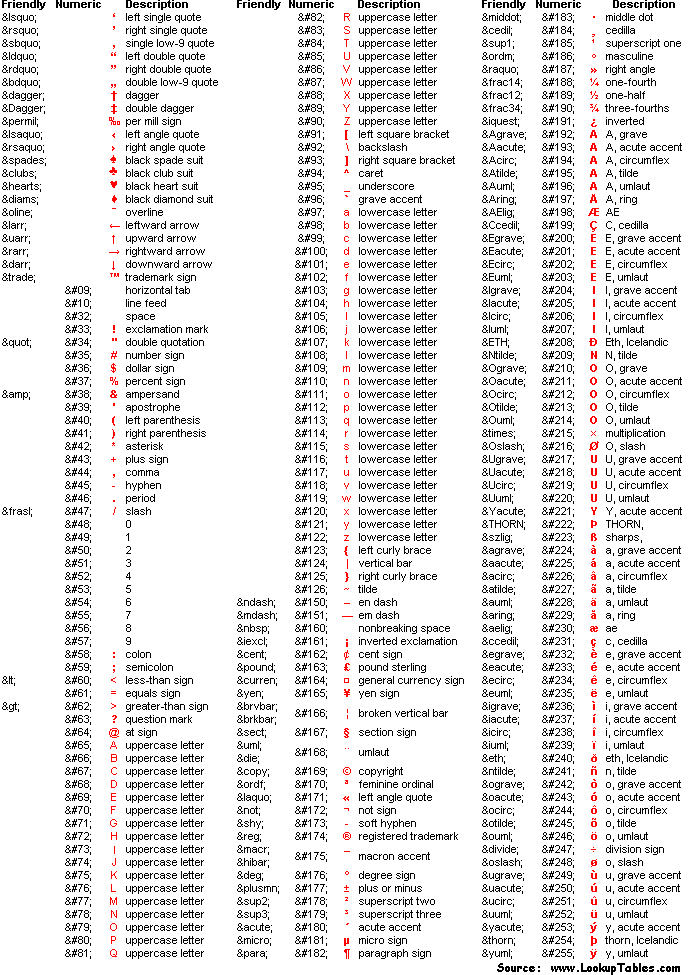
What's ASCII? ASCII stands for American Standard Code for Information Interchange. Computers can only understand numbers, so an ASCII code is the numerical representation of a character such as 'a' or '@' or an action of some sort. ASCII was developed a long time ago and now the non-printing characters are rarely used for their original purpose. Below is the ASCII character table and this includes descriptions of the first 32 non-printing characters. ASCII was actually designed for use with teletypes and so the descriptions are somewhat obscure. If someone says they want your CV however in ASCII format, all this means is they want 'plain' text with no formatting such as tabs, bold or underscoring - the raw format that any computer can understand. This is usually so they can easily import the file into their own applications without issues. Notepad.exe creates ASCII text, or in MS Word you can save a file as 'text only'.

Extended ASCII Codes
As people gradually required computers to understand additional characters and non-printing characters the ASCII set became restrictive. As with most technology, it took a while to get a single standard for these extra characters and hence there are few varying 'extended' sets. The most popular is presented below.

HTML Codes
To get special characters to show on an HTML web page, special codes can be used (ASCII code or word) and are interpreted by the web browser.
Outside the programming, you can also use these ASCII Codes by pressing "Alt + number". But, sometimes that won't work in special gadget ☺ Cheers!
-Jean
Posted in :
ASCII,
Codes,
Computer,
HTML,
Programming
|

Are you interested in computer programming? Well, you may be interested with what will I serve to you now.
The International Olympiad in Informatics (IOI) is one of the most recognized computer science competitions in the world. The competition tasks are of algorithmic nature; however, the contestants have to show such basic IT skills as problem analysis, design of algorithms and data structures, programming and testing. The winners of the IOI belong to the best young computer scientists in the world.
The IOI is one of the International Science Olympiads. The primary goal of the IOI is to stimulate interest in informatics (computing science) and information technology. Another important goal is to bring together exceptionally talented students from various countries and to have them share scientific and cultural experiences.
Students compete on an individual basis, with up to four students competing from each participating country (with around 81 countries in 2004). The students compete individually and try to maximize their score by solving a set of informatics problems during two competition days. The problems have been algorithmic programming problems to be solved on a personal computer. Cultural and recreational events are organized on the remaining days.
Interesting, huh?
Well, if you're still at Junior High School, prepare yourself from now on, so that you can join IOI later on.
Want to know more about IOI?
Click here to open IOI Official Site!
Slash news:- This 22nd IOI will be held at
Waterloo, Ontario, Canada, August 14-21 2010.- For Indonesian students, you must pass from
OSN first to represent Indonesia at IOI.
- The tests will be about programming and logic (logic math included).
- I'll give some games and story to sharpen your logic next time! :)
-Jean
Posted in :
Computer,
Informatics,
International,
IOI,
Olympiad,
Programming
|